
Disclaimer: I own shares in VECO 0.00%↑
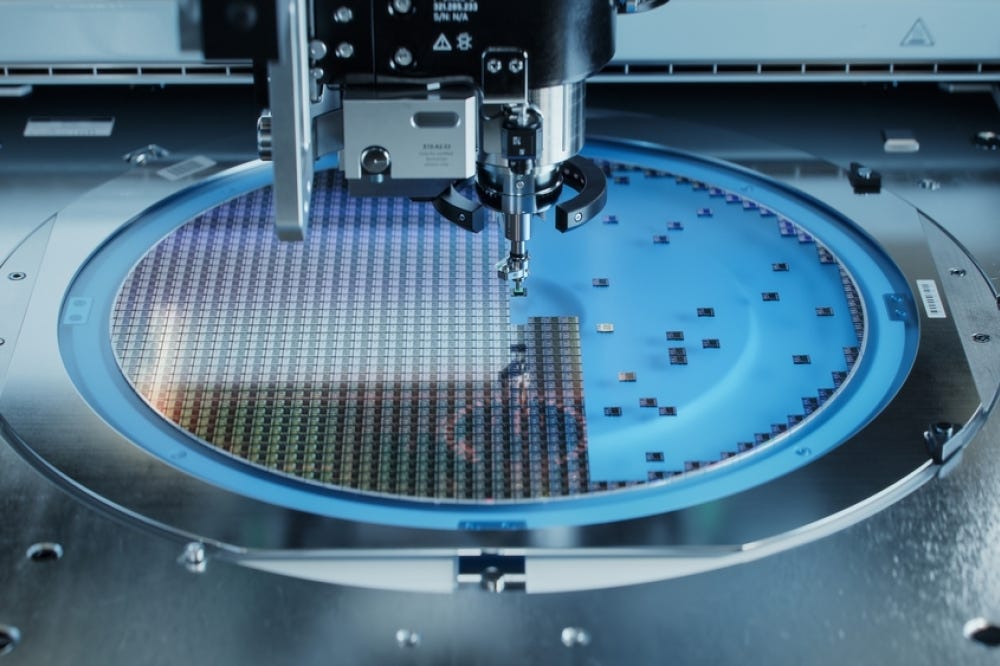
Veeco Instruments VECO 0.00%↑ holds monopoly or near-monopoly positions in several semiconductor equipment niches that happen to sit directly in the path of the largest capital expenditure cycles in the industry right now: HBM and advanced DRAM, silicon photonics, EUV lithography, and advanced packaging for AI chips. Yet the stock is only trading at ~16x my forward estimates. In this article, I'll cover Veeco's core product lines and why each one maps to a major semiconductor growth cycle, walk through my 2026 financial estimates and break down the pending Axcelis merger — both the strategic upside and the risks it introduces to the thesis.
The Setup: A Niche Equipment Maker at the Center of Everything
Veeco is not a well-known name, even among semiconductor investors. It doesn’t have the brand recognition of Applied Materials, Lam Research, KLA or ASML. But it does have a collection of niche-dominant process equipment platforms that happen to sit at the exact chokepoints of the three biggest semiconductor buildouts of the next decade: HBM/DRAM scaling, silicon photonics, and advanced packaging for AI.
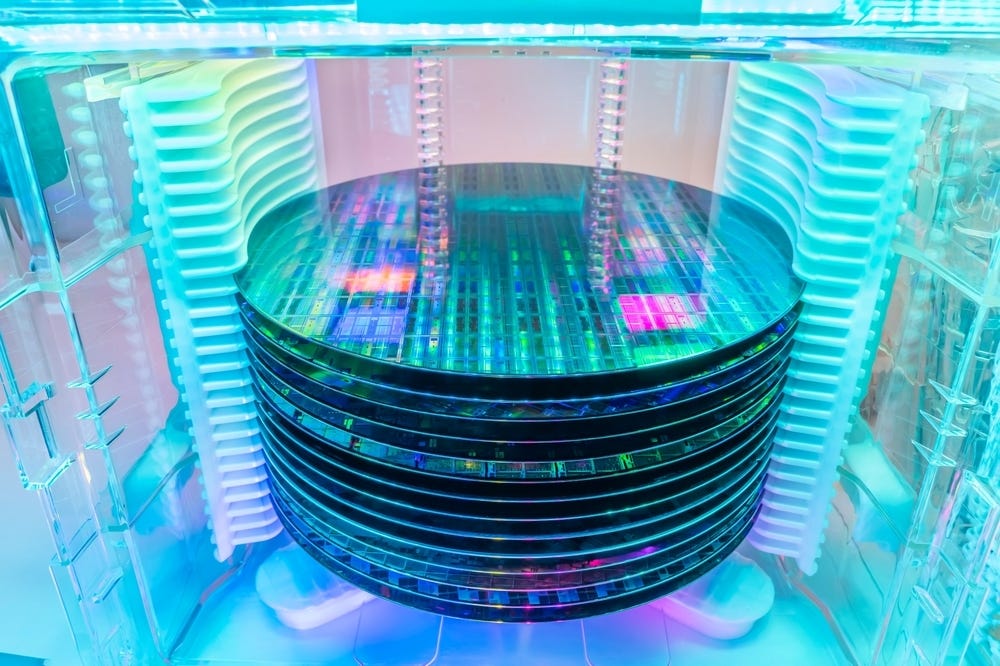
The product portfolio is worth understanding in detail, because each piece connects to a different mega-trend:
Laser Spike Annealing (LSA) — Critical for manufacturing gate-all-around (GAA) transistors at the 3nm and 2nm nodes, and increasingly essential for advanced DRAM. These systems deliver millisecond-scale, high-temperature annealing with thermal precision that traditional furnace methods can’t match. Veeco is the technology leader in this segment.
Ion Beam Deposition (IBD) — Veeco holds what amounts to a virtual monopoly on IBD tools for EUV mask blanks. Every EUV lithography system that ASML ships needs mask blanks made with Veeco’s IBD technology. The company is now expanding IBD into front-end semiconductor deposition with the IBD300, targeting DRAM and logic applications.
MOCVD and MBE Epitaxial Systems — These grow the compound semiconductor layers (GaN, InP, and now barium titanate) needed for laser diodes, power electronics, and photonic devices. As the silicon photonics market scales, these tools become the enabling infrastructure.
Wet Processing and Lithography (WaferStorm, WaferEtch, AP300) — These have become foundational to advanced packaging workflows including CoWoS, HBM stacking, and fan-out wafer-level packaging. This segment doubled in 2025.
What makes Veeco unique is that it doesn’t compete head-to-head with the equipment giants across broad process flows. Instead, it dominates specific, high-value process steps where it has built genuine technological moats. That’s a very strong position to be in since it has lower competitive risk, higher pricing power, and maintains direct exposure to the most critical manufacturing bottlenecks.
The Memory Boom: HBM and Advanced DRAM
The HBM market is growing at a pace that is difficult to overstate. Micron recently pulled forward its projection for HBM to reach a $100 billion total addressable market from 2030-2028, implying roughly 40% compound annual growth from the approximately $35 billion expected in 2025. SK Hynix, which controls roughly 60-70% of HBM production, has capacity sold out through 2026 and beyond. Samsung has begun commercial shipments of HBM4. Every one of these major memory manufacturers is building or planning new fab capacity.
Veeco touches this buildout through three separate product lines, which is what makes the opportunity so compelling.
LSA in DRAM: Veeco’s laser spike annealing platform is already a production tool of record at a leading HBM DRAM customer (likely SK Hynix). In December 2025, the company shipped an LSA evaluation system to a second tier-1 DRAM manufacturer for advanced DRAM R&D (likely Samsung), with follow-on production orders expected in 2027 and beyond.
IBD300: This is where the story gets really interesting. IBD300 is Veeco’s 300mm ion beam deposition system that provides a fundamentally different approach to depositing thin metal films on wafers compared to the conventional PVD sputtering that dominates the market today.
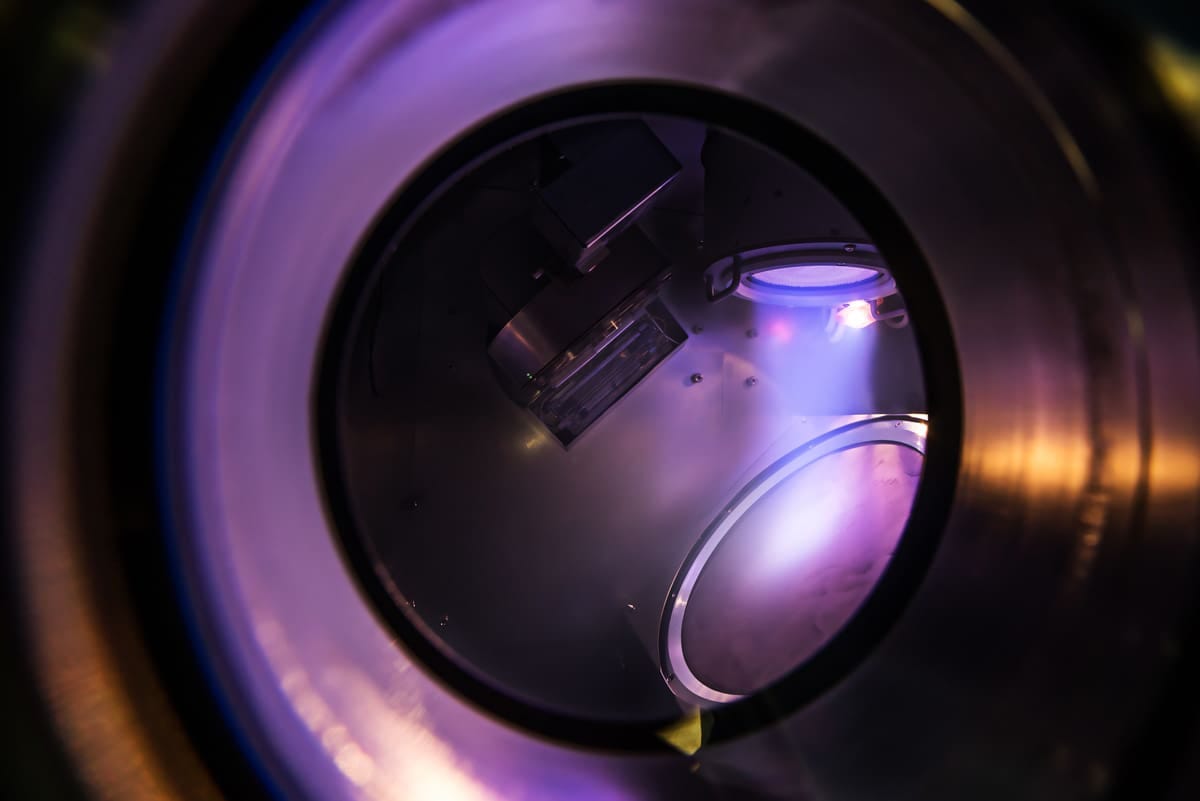
Here’s why it matters: As memory manufacturers shrink DRAM nodes and stack more layers for HBM, the metal wiring inside chips gets narrower and the tolerance for resistance losses shrinks. The IBD300 solves this by controlling the grain orientation and grain size of deposited metals far more precisely.
Veeco shipped the first IBD300 to a tier-1 memory customer for evaluation in late 2023. As of the most recent earnings call, two IBD300 systems are under evaluation at leading DRAM customers, with those evaluations extending into 2026. If these evaluations convert to production adoption, and the physics argument for why they should is strong, it opens an entirely new front-end deposition market for Veeco that has historically been the exclusive domain of Applied Materials and Lam Research.
Advanced Packaging: Veeco’s wet processing and lithography business for advanced packaging doubled from $75 million to $150 million in 2025, driven directly by AI-related demand. The company announced over $50 million in wet processing orders supporting advanced packaging for AI, and also signed an agreement with IBM to explore wet processing systems for advanced packaging applications. Management highlighted on the Q4 call that this segment is expected to continue growing as HBM4, HBM4E, and next-generation packaging ramp in 2026 and beyond.
The thesis is simple: more HBM fabs = more Veeco tools across LSA, IBD, and packaging. And the HBM buildout is just getting started.
The Photonics Boom: The Catalyst Nobody’s Modeling
The photonics industry is Veeco's real dark horse. Wall Street has only recently begun to take notice of the massive buildout underway in silicon photonics, and has yet to reprice the equipment makers that will benefit for years to come. As optical transceiver manufacturers race to expand fab capacity with supply currently sold out into 2028, companies like Veeco that supply the critical deposition and processing tools are sitting directly in the path of billions in new capex that hasn't been modeled yet.
The silicon photonics market is expected to grow from roughly $2-3 billion in 2025 to somewhere between $10 billion and $28 billion by the early 2030s, depending on the source, at 25-30% CAGRs. AI data centers need to move data between GPUs, switches, and storage at speeds that copper interconnects physically cannot achieve. Light is faster, more energy-efficient, and can carry more bandwidth per channel. Every Nvidia H200 server unit requires approximately 2.5 800G optical transceivers, and 1.6T and 3.2T modules are already in development. Industry estimates project the optical transceiver market for datacom to grow from $2.9 billion in 2024 to $13.1 billion by 2030.
Veeco is positioning itself at multiple points in this supply chain:
MOCVD for Photonic Components: Veeco’s GaN and AsP MOCVD platforms grow the III-V compound semiconductor epitaxial layers needed for the laser diodes and photonic components inside optical transceivers. In October 2025, Veeco launched its Lumina+ MOCVD system and received a multi-tool order from a leading optical communications laser manufacturer. That same month, the company received multiple orders for wet processing and lithography systems from a leading specialist foundry (likely GlobalFoundries or Tower Semiconductor) specifically for silicon photonics applications, with deliveries beginning in Q1 2026. Management expects a meaningful ramp in this segment in 2H 2026. Management also stated in their most recent quarterly earnings call that this product generates a higher gross margin than their current company average (current avg of 41%), meaning profitability will accelerate at a faster pace as this segment grows.
MBE for Next-Generation Photonics Materials: In January 2026, Veeco and imec — the world’s leading nanoelectronics research center — announced they had developed a 300mm manufacturing-compatible process for integrating barium titanate (BTO) on silicon photonics platforms. BTO can modulate light faster, at lower voltages, and in a smaller footprint than current silicon modulators, which are hitting real performance walls as the industry pushes toward 1.6T and 3.2T transceivers. The problem has always been that nobody could manufacture it at scale — and Veeco is now the only company with a production-compatible system that can.
I want to be realistic about the timeline though. BTO isn’t the only alternative material in the race — thin-film lithium niobate is further along commercially, and the industry could standardize on a “good enough” solution before BTO reaches volume production. This is realistically a 2028-2030 revenue story. But that’s exactly what generates a potential mispricing. Veeco is developing next generation equipment, partnered with the most credible R&D institution in the world. If BTO gains traction, Veeco owns the only manufacturing tool for it. In the meantime, the near-term photonics revenue is coming from the MOCVD and wet processing orders that are already shipping today.
The Numbers: Standalone Veeco Bull Case
Let me walk through what I think Veeco can deliver over the next two years.
2025 Actuals:
Revenue: $664M (down 7.4% YoY — the cyclical trough)
Non-GAAP EPS: $1.33
Advanced packaging revenue: ~$150M (doubled from $75M in 2024)
Gross margin: ~40%
Record semiconductor revenue driven by LSA, wet processing, and ion beam for EUV
Management’s 2026 Guidance: $740-800M revenue, $1.50-$1.85 non-GAAP EPS (vs. consensus of ~$700M and $1.21 when guidance was issued — well above the street’s expectations).
My 2026E Bull Case: $820M revenue, ~$2.00 non-GAAP EPS
This sits above the top end of management's $740-800M guidance, but management has a track record of guiding conservatively. When they issued 2026 guidance, the Street was at $700M. They guided $740-800M, and bookings accelerated in H2 2025 with backlog expanding heading into the year. An $820M outcome only requires modest upside from the tailwinds already visible in the order book.
Where does the upside come from?
Advanced packaging continues its growth trajectory: ~$200M+ (vs. $150M in 2025)
LSA gains share at a second DRAM customer as evaluation converts toward production commitment
IBD300 begins contributing initial revenue as evaluation-stage systems are followed by additional shipments
Photonics MOCVD and MBE orders ramp as foundries build out silicon photonics lines
Gross margin expands to ~43% on mix shift toward higher-margin semiconductor tools (management is targeting 45% by the back half of 2026)
At ~$33/share (at the time of writing), the stock trades at roughly 16.5x my 2026E EPS, very low for a company guiding 20%+ revenue growth with multiple secular tailwinds and monopoly-like positions in critical niches. Competitors with similar AI-exposure trade at 22x to 25x forward earnings. If the market eventually grants Veeco a similar multiple on my $2.00 EPS estimate, the mathematical outcome is significantly higher than today’s price.
The Merger with Axcelis: What It Means
Veeco is merging with Axcelis Technologies ACLS 0.00%↑ in an all-stock deal expected to close in H2 2026. Both shareholder bases have approved it. The exchange ratio is fixed at 0.3575 NewCo shares per VECO share. Upon close, Axcelis shareholders will own ~58% and Veeco shareholders ~42% of the combined entity, which will get a new name, new ticker, and be headquartered in Beverly, Massachusetts.
This merger is the most important variable for VECO shareholders beyond the standalone fundamentals, so let me break down both what could go right and what could go wrong.
What Axcelis Brings to the Table
Axcelis is the leading pure-play ion implantation company — and ion implantation is one of the most critical steps in semiconductor manufacturing. Every chip gets implanted. Their Purion platform covers high-current, high-energy, and medium-current applications across logic, memory, power, and image sensor markets.
Key strengths:
SiC and Power Electronics Leadership: Axcelis’s Purion Power Series dominates the silicon carbide ion implant market. SiC chips are essential for EVs, renewable energy infrastructure, and industrial power systems. While SiC capex is currently in a cyclical trough (Axcelis revenue fell from $1.13B in 2023 to $839M in 2025 as customers digested capacity), the long-term trajectory is strong. The SiC power device market is projected to see substantial growth as EV adoption continues globally and grid electrification accelerates to accommodate AI data centers. When SiC capex recovers (and it will) Axcelis will rebound rapidly.
Growing Aftermarket Business: Axcelis’s CS&I (Customer Support & Integration) segment grew 14% YoY to record levels in 2025, with upgrades and services at all-time highs. This is recurring, high-margin revenue that stabilizes the business through cycles. As the installed base of Purion systems grows, this stream compounds.
Fortress Balance Sheet: Zero long-term debt. The combined entity will have over $900M in cash, providing significant flexibility for R&D investment, share repurchases (management has already indicated buyback plans post-close), and weathering any cyclical downturns.
Memory Market Expansion: Axcelis is seeing improving demand trends in memory — their Q4 2025 results exceeded outlook, and management expects memory momentum to continue in 2026. The new Purion H6 high-current implanter targets advanced logic, image sensors, and high-end memory applications, expanding Axcelis’s addressable market.
The Strategic Logic: Why 1+1 Could Equal More Than 2
The bull case for the combination centers primarily around what the combined R&D engine and product portfolio can achieve together.
Complementary Technology Platforms: Veeco and Axcelis both specialize in beam-based processing technologies (ion beam deposition/etch for Veeco, ion implantation for Axcelis). The combined R&D budget gives the new company the scale to compete more aggressively with the Big Three (Applied Materials, Lam Research, KLA) while maintaining the specialist focus.
Expanded Addressable Market: On a standalone basis, Veeco’s served addressable market is roughly $2-3B. Axcelis adds ion implantation ($1.5-2B+ market, growing with SiC). The combined entity will have a served addressable market exceeding $5 billion.
Cross-Selling Opportunities: The combined company will have relationships with essentially every major logic, memory, and power semiconductor manufacturer globally. Veeco’s advanced packaging and photonics tools can be introduced to Axcelis’s customer base, and vice versa.
Diversification Through Cycles: Veeco’s growth is currently driven by AI/HBM (semiconductors and packaging). Axcelis’s growth will be driven by the SiC recovery (power electronics). These cycles don’t perfectly correlate, which means the combined entity should have smoother revenue through industry ups and downs — a quality that often commands a higher multiple.
Scale Benefits: The combined company will be the fourth-largest US-based semiconductor equipment manufacturer. Scale matters in this industry for procurement leverage, service infrastructure, and credibility in winning evaluation slots at tier-1 customers.
The Risks of the Merger
I’d be doing you a disservice if I didn’t lay out the other side.
Axcelis’s Near-Term Stagnation Could Weigh on the Multiple: Axcelis consensus is ~$816M in 2026 revenue, essentially flat from 2025’s $839M, with analyst projections showing roughly $836M by 2028. Until SiC capex recovers, Axcelis is contributing revenue but not growth. On a pro forma basis, Axcelis represents roughly half of combined revenue — and that half could be growing at 0-5% while Veeco’s half grows at 20%+. The blended growth rate looks less impressive and will potentially compress the multiple relative to what standalone Veeco might command.
Regulatory Risk: The merger still requires final approval from China’s SAMR (State Administration for Market Regulation). In the current geopolitical environment, Chinese regulatory approval for US semiconductor equipment deals isn’t guaranteed, though both companies have significant China exposure, which arguably makes approval more likely since blocking the deal could disrupt equipment supply to Chinese fabs.
Dilution of the Pure-Play Narrative: One of Veeco’s strengths as an investment is its clear exposure to AI/HBM/photonics mega-trends. Post-merger, that narrative gets diluted by Axcelis’s SiC/power story, which is compelling long-term but in a trough right now. Investors who bought VECO for the AI thesis may not want exposure to a stagnating SiC cycle.
Other Risks
China Exposure and Tariff Risk
Veeco generates a significant portion of revenue from China. The company experienced disruptions in 2025 from tariff-related shipment delays (including ~$15M of laser annealing systems held in customs), and management has baked a roughly 100 basis point gross margin headwind from tariffs into 2026 guidance. Escalation in export controls or trade tensions could materially impact demand.
IBD300 Evaluations May Not Convert
The two IBD300 systems under evaluation represent a genuinely new market opportunity, but evaluations are not guaranteed orders. If tools don’t meet expectations, or if customers decide conventional PVD is sufficient for their next-generation nodes, this vector disappoints.
Cyclicality
Semiconductor equipment is inherently cyclical. A broader spending downturn driven by macro slowdown, inventory correction, or AI spending pullback would pressure the top line, though this scenario seems unlikely before 2028+.
Valuation Risk If Growth Disappoints
My bull case assumes above-guidance revenue. If Veeco merely meets the midpoint of guidance ($770M in 2026), the stock at $33 is roughly fairly valued should multiples remain the same. The upside case requires the growth catalysts to deliver.
Conclusion: Buying the Growth Engine at a Discount
Veeco makes equipment that memory manufacturers, photonics foundries, and advanced packaging houses need in order to build the infrastructure behind AI. That equipment is shipping today, the order book is growing, and the end markets are scaling at 25-40% CAGRs depending on the segment.
The demand signals are not subtle:
HBM capacity is sold out through 2026. Micron pulled forward the $100B TAM to 2028. Every memory manufacturer is expanding.
Silicon photonics is growing at 25-30% CAGR. Tower Semiconductor has committed $920M in photonics capex to 5x their SiPho wafer capacity, with over 70% already reserved by customers through 2028. GlobalFoundries is nearly tripling its capital intensity in 2026, citing silicon photonics as a key area where they are oversubscribed. Veeco's epitaxial and wet processing tools are already shipping into these buildouts.
Advanced packaging revenue doubled in 2025 to $150M and shows no signs of slowing as HBM4 ramps.
Two IBD300 systems are under evaluation at tier-1 DRAM customers, a potential TAM expansion into a market Veeco didn’t even participate in two years ago.
Bookings accelerated in H2 2025, and backlog is expanding heading into 2026.
The stock is cheap because the market is looking at a slow 2025 financial year and a pending merger with a slower-growing partner, and assigning them a low multiple. What it’s not pricing is $800M+ in 2026 revenue, expanding gross margins, and a product portfolio that touches HBM, DRAM, EUV, silicon photonics, and advanced packaging simultaneously. There aren’t many, if any, equipment companies with that kind of exposure to the fastest growing industries in the world trading at 16-17x earnings.
The Axcelis merger adds complexity, but it also adds $900M+ in combined cash, zero long-term debt, a $5B+ served addressable market, and optionality on a SiC recovery that could meaningfully accelerate the combined entity’s growth rate. The downside is well-supported. The upside depends on how many of Veeco’s growth vectors convert and the evidence so far suggests more of them will than the market is giving credit for.
Disclaimer:
The content in this article is for informational and entertainment purposes only and does not constitute financial, investment, or legal advice. I am not a licensed financial advisor. All investment strategies and investments involve risk of loss. Please do your own research and consult with a certified financial professional before making any financial decisions.
great work on the detailed research
Well written🙏