
Disclaimer: I own shares in Corning GLW 0.00%↑ .
TLDR
Corning is a key player in the adoption of photonics. Their optical fiber solutions have been adopted by every major hyperscaler.
Their subsidiary, Hemlock Semiconductor, is a structural bottleneck in semiconductor and solar wafer production. Hemlock semiconductor is one of five companies across the globe capable of creating hyper-pure polysilicon.
Corning has a monopoly on the made-in-America solar business. From Hemlock Semiconductor to their partnership with T1 Energy, Corning is the key beneficiary of the American solar buildout.
Corning recently signed a blockbuster $6 billion deal with Meta. Corning will supply Meta with optical fiber for the buildout of all 26 of their data centers.
The Photonics Transformation
As AI-GPU technology advances at a breakneck pace, data center interconnectivity acts as a serious bottleneck for compute. Traditional cloud-oriented data centers and early generation AI data centers used lots of copper wire, as it is cheap and has high conductivity, to transmit data at speeds of 10-25G. Now that AI-GPU data centers require much faster transfer speeds, ranging from 100G-800G, extraordinary lengths of fiber optic cables are required to connect individual GPUs and racks at scale. When you push more data (higher frequencies) through copper wire, the signal degrades rapidly and the wire generates more heat. Instead of sending data in the form of electrons through a metal wire, the industry has shifted to optical fiber, using lasers to send pulses of light (photons) through specialty glass. Since this light does not suffer from electrical resistance, it travels through the medium without producing heat, and can travel exponentially further without experiencing issues. This transformational shift inside the data center is fueling a massive surge in sales for Corning’s highly engineered glass.
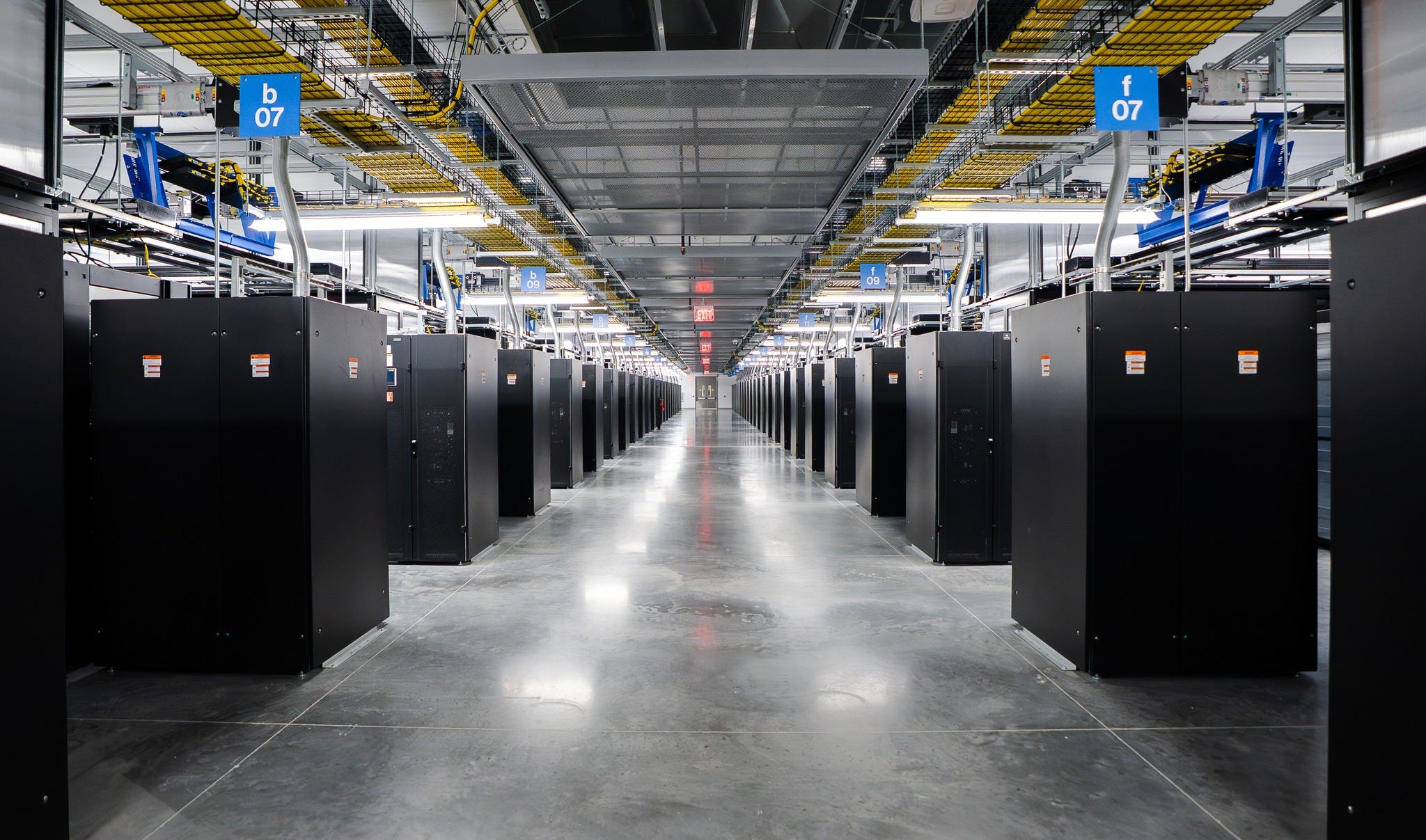
Image Source: Meta Kansas City Data Center
Corning’s glass not only allows companies to fully utilize 800G connectivity, but it allows them to do so with efficient space management. While moving from 100G to 800G technically requires 8 times the optical fiber content, Corning has engineered their fiber to pack thousands of individual strands into a single cable with up to a 60% smaller diameter.
On January 27th of this year, Corning announced a monumental, multi-year deal to supply Meta with up to $6 billion of optical fiber, cable, and connectivity solutions. Meta plans to build 26 data centers in the U.S., all requiring Corning’s technology. According to Corning CEO Wendell Weeks in a recent CNBC interview, Meta isn’t even Corning’s largest hyperscaler customer, putting into perspective the massive demand coming from other customers. Corning supplies the vast majority of Nvidia, AWS, Google and OpenAI’s optical fiber, giving them a practical monopoly on the U.S. data center buildout. Corning’s robust domestic business, which accounts for about 40% of their overall sales, is bolstered by their international business which supplies many international data center customers. Corning has manufacturing facilities for their optical fiber in key countries across the world, including China, India and Poland. This deep international manufacturing buildout shields their business from geopolitical vulnerabilities and allows them to sell directly to local customers at lower cost. Corning recently reported FY net sales up 35% YoY in their optical communications segment.
The Polysilicon Bottleneck
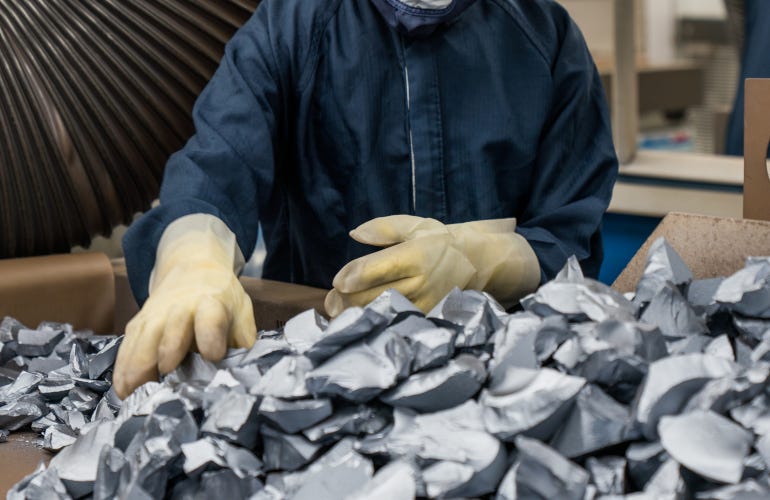
Image Source: Hemlock Semiconductor
The production of a solar panel starts with polysilicon, the fundamental material of photovoltaic solar cells and semiconductors. Corning, through their 80.5% ownership in Hemlock Semiconductor, is the only American headquartered producer of ultra-pure polysilicon and one of only FIVE companies in the entire world capable of producing hyper-pure polysilicon (according to the U.S. Dept. of Commerce) needed to produce cutting-edge semiconductors. Hemlock Semiconductor’s polysilicon is a structural bottleneck for the entire global chip industry, and the buildout of domestically produced solar arrays. Through Hemlock Semiconductor, Corning supplies itself with polysilicon to produce solar ingots and wafers, the next step in the value chain of solar production. For the first time in years, Corning has successfully managed to onshore solar wafer production, of which China currently produces 97% of the global supply. In late 2025, Corning signed a strategic partnership with TE 0.00%↑ T1 Energy to supply them with solar wafers needed in the production of solar cells at their new Texas solar cell fab, going online in late 2026. From the polysilicon at Hemlock to the solar cell at T1 Energy, Corning fills a unique position in the market as the only supplier of entirely American-made solar products, which is vital for energy companies and hyperscalers looking for strong supply chains in today’s unstable geopolitical environment. Corning Q4 sales for Hemlock Semiconductor and Emerging Growth Businesses are up 62% YoY, with expectations of building their solar business to $2.5 billion in revenue by 2028 with profitability at or above their company average.
As chip designs for Nvidia and AMD’s GPUs shrink down to the 3 and 2 nanometer range, ultra-pure polysilicon becomes absolutely necessary when manufacturing these architectures at the atomic scale. Since Hemlock Semiconductor is the only U.S. owned producer of this grade of polysilicon, they are essentially guaranteed to capture the vast majority of the subsidized domestic demand. Although the CAGR of polysilicon demand is around the ~10% range, the rapid buildout of American semiconductor and solar fabs will likely boost this figure far beyond expectations, especially for Hemlock.
Other Businesses
Corning operates several other significant and transformational businesses.
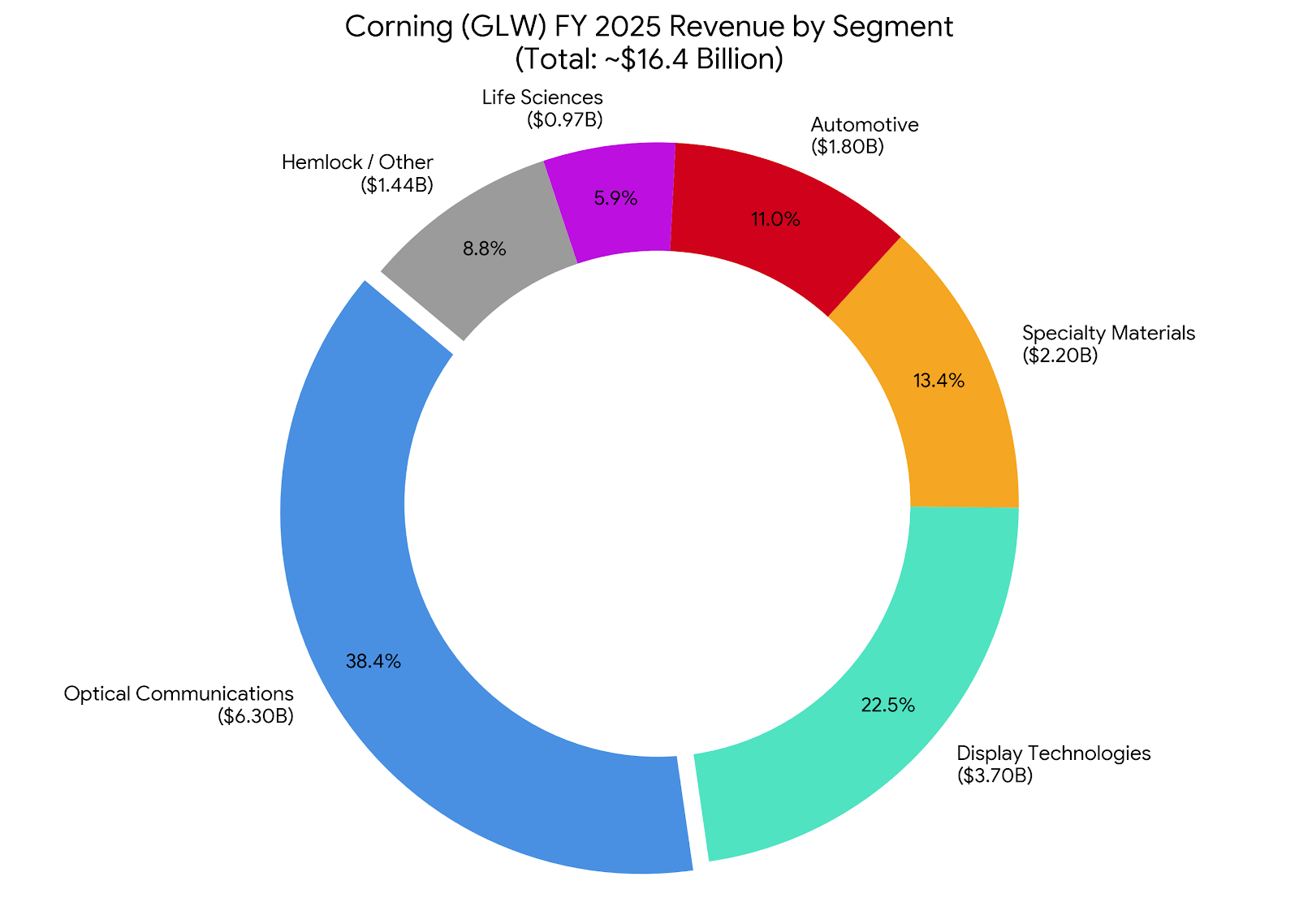
Display technology segment: Corning manufactures flat-panel displays, OLEDs and large TVs. The display technology segment, generating $3.7 billion in revenue, is guiding for flat to low-single digit growth. Although this segment is not expected to provide meaningful growth for the company, it has high net income margins of 27%, generating $993 million in profit for Corning in FY 2025. This cash-cow business helps fund Corning’s rapid expansion of production facilities in its faster growing businesses.
Specialty Materials: Covers their glass production for “Gorilla Glass” and “Ceramic Shield” (Apple AAPL 0.00%↑) for mobile devices, wearables, AR/VR and semiconductor manufacturing equipment such as EUV lithography machines ASML 0.00%↑. In 2025, Specialty Materials generated $2.2 billion in revenue (+10% YoY), with $367 million in net income and a 16.6% net income margin. The growth of Specialty glass demand is expected to remain high, with new innovations in the AR, VR and foldable industry and necessity in advanced semiconductor manufacturing being the primary growth drivers.
Automotive: Corning produces ceramic substrates and filters for combustion engines, as well as glass for dashboard displays and Gorilla Glass for windshields. Automotive generated $1.8 billion in sales for FY 2025 (-3% YoY), with $278 million in net income. This business is expected to remain flat or slightly decline, but operational efficiencies will keep profitability stable.
Life Sciences: Manufacturers of consumable lab equipment, cell culture products and bioprocessing tools for pharmaceutical companies and researchers. Life Sciences grew rapidly during the COVID-19 pandemic, as they produced the vials necessary to store mRNA vaccines, which had to be stored as low as -70°C. Since 2021, this business has been steadily declining, now sitting at $972 million in revenue, with only $61 million in net income. A significant oversupply of inventory sits with pharmaceuticals, which is expected to normalize by the end of this year.
Potential Risks
Corning is spending billions to build vast production facilities, including their North Carolina facility which is the world’s largest fiber-optic cable plant. If the AI data center buildout slows in the future and factories aren’t producing at maximum capacity, there will be detrimental compression of their profit margins. A similar scenario previously decimated their business after fiber optic saw a rapid decline in growth following the dot-com bubble.
Strict U.S. tariffs are a significant tailwind for Corning’s solar business and Hemlock Semiconductor, while also posing as their largest risk. If the U.S. market opens up to cheap polysilicon and Chinese solar wafers, the inherently higher costs of Corning’s American manufacturing will be their downfall.
Customer Concentration: Corning’s small quantity of rich clients also pose a risk, since just a handful of their customers make up a significant portion of their revenues. Macro-spending shifts among top companies could rapidly impact Corning’s business.
Conclusion:
Corning has successfully shifted from a legacy materials manufacturer, becoming the backbone of the AI and domestic energy revolution. By positioning themselves at the exact intersection of the market’s two biggest physical bottlenecks (compute interconnectivity and power generation) they have essentially become an unavoidable tollbooth for the world’s most cash-rich companies.
Their dual-engine growth narrative is highly unique in the materials sector:
The AI Nervous System: With a practical monopoly on the U.S. optical fiber buildout and massive commitments from hyperscalers like Meta, Corning’s highly engineered glass is the only way to physically push 800G and 1.6T data across AI clusters efficiently.
The Domestic Energy Monopoly: Through Hemlock Semiconductor and their partnership with T1 Energy, they are the sole American provider of the hyper-pure polysilicon required to satisfy the subsidized, “Made in America” solar and semiconductor supply chains.
However, this explosive transformation is not without immense stakes. Corning is currently executing a hyper-aggressive, capital-intensive expansion funded by their legacy Display and Specialty Materials businesses. Their vulnerability is directly tied to a handful of ultra-rich clients and the protection of strict U.S. trade policies. If the AI capital expenditure cycle suddenly cools, or if a shift in Washington removes the tariff walls protecting their domestic solar production, their billion-dollar factory investments could quickly become margin-crushing liabilities.
Corning is a high-conviction play betting that the physical limits of AI compute and the geopolitical fracturing of global supply chains are long-term realities. If management can successfully navigate the risks of this speedy capacity ramp-up, Corning is primed to capture a generational wealth transfer.
Corning is currently sitting at 5% of my overall portfolio.
Disclaimer:
The content in this article is for informational and entertainment purposes only and does not constitute financial, investment, or legal advice. I am not a licensed financial advisor. All investment strategies and investments involve risk of loss. Please do your own research and consult with a certified financial professional before making any financial decisions.
Thorough and well written. Great piece.